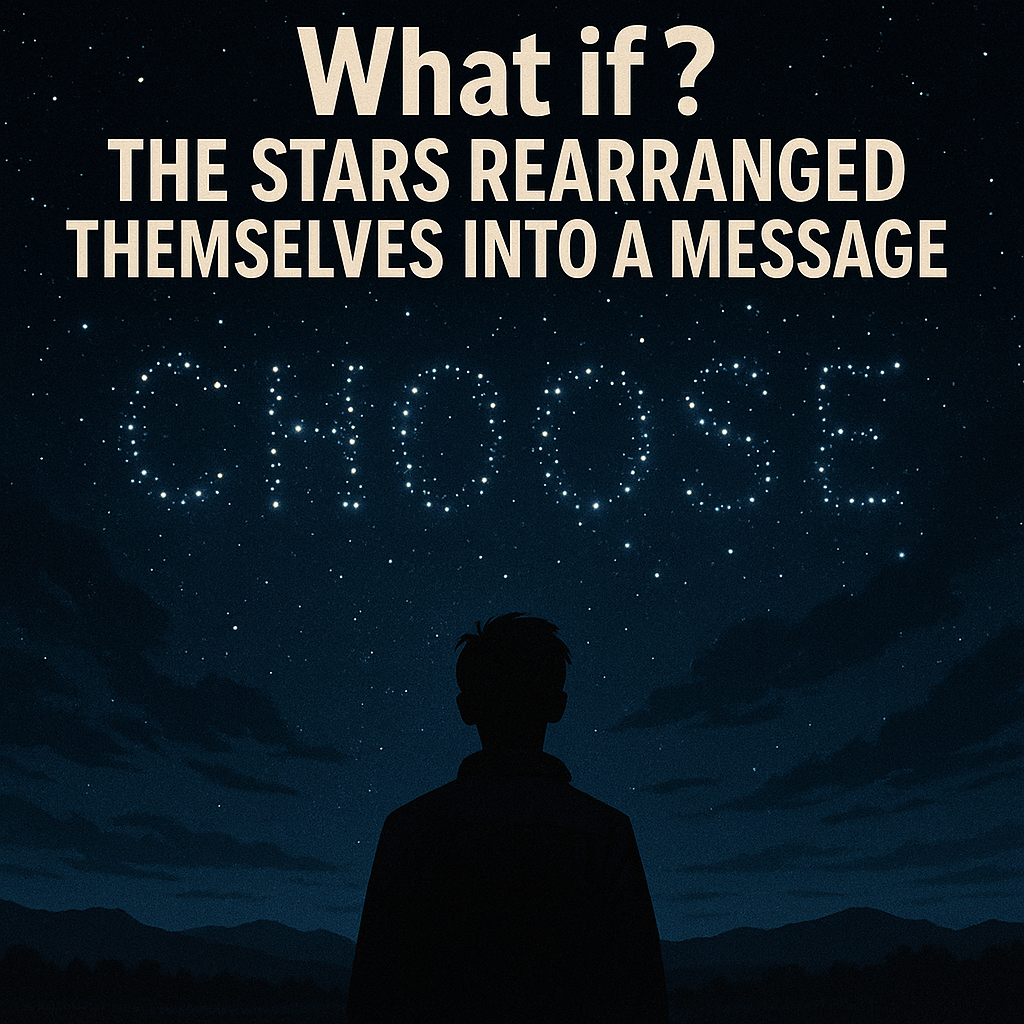
When the stars begin to move across the night sky and rearrange themselves into messages only humans can see, the world panics as astronomers discover the “stars” are actually ancient machines returning to judge humanity’s readiness. Their messages grow personal, culminating in a global demand: “Who speaks for Earth?” Guided by a young girl mysteriously connected to the cosmic visitors, humanity faces a collective vote on whether it wants to continue existing in its current form. After a near-even psychic tally, the celestial machines accept humanity’s choice to grow rather than surrender—and silently withdraw, leaving a single displaced star as a promise that they will return when humanity is truly ready.
I. The Night the Sky Learned to Move
It began at 2:14 a.m. on a warm June night, when a sleepy graduate astronomy student named Dana Yarrow took a final look through her university observatory telescope before locking up and heading home, expecting nothing more than a faint scatter of quiet constellations overhead. Instead, she witnessed a star—one she had catalogued dozens of times—slowly drifting across the lens, as though the entire dome of the heavens had been nudged by some incomprehensible hand.
She blinked, adjusted the focus, checked her calibration, and felt her stomach hollow out when the star continued its impossible, deliberate movement, sliding across the black canvas with measured purpose rather than random drift. Before she could call her advisor, three more stars detached from their ancient positions and followed the first, gliding with eerie synchronicity toward a point she couldn’t identify.
Across the planet, pilots reported “celestial misalignment,” night-shift workers walked outside to rub their eyes in disbelief, and millions of phones captured what looked like a massive, silent migration of starlight. The stars weren’t twinkling. They weren’t shimmering.
They were moving.
By 2:25 a.m., every news broadcast on Earth interrupted itself. By 2:27, all astronomers were on alert. By 2:41, religious leaders, military commanders, and philosophers were awake, watching the impossible unfold.
And by 3:00 a.m., the sky had rewritten itself.
Into words.
Huge, brilliant, perfect words stretching across the continents, visible from every corner of Earth.
The message read:
WE SEE YOU.
II. The World Tries to Understand
Panic was instantaneous, but so was awe. Streets worldwide filled with people in pajamas, pointing upward at the giant, glowing sentence that hung above them like a cosmic billboard. Children asked their parents who was speaking. Parents had no answers.
Governments convened emergency sessions, their leaders attempting to maintain calm while silently trembling. Every radio frequency buzzed with speculation; every social network collapsed under the weight of global hysteria.
Scientists confirmed the unthinkable: Stars separated by dozens of light-years had coordinated in perfect simultaneity, synchronized in a way no known natural force could explain.
But then something stranger occurred.
The message changed.
The stars shifted again—not drifting now, but rearranging with mechanical precision, as though responding to unseen instructions, forming a second sentence:
ARE YOU READY?
Ready for what? No leader could answer. No algorithm could model the intent. No telescope could find the mechanism.
But deep in the silence of the night, something else was happening—something only humans noticed.
Because cameras captured nothing. Sensors saw nothing unusual. Satellites detected no movement.
Only the human eye could see the message.
It was not written in space. It was written inside minds.
III. Personalized Heavens
By sunrise, people around the globe realized something even more bizarre.
Different regions saw different messages.
Over France, the stars spelled:
RÉPONDRE.
Over Brazil:
VOCÊ ESCOLHE.
Over Egypt:
أَجِبْ.
Over remote villages with no literacy:
The stars formed images—a hand reaching down, or a door slightly open, or a path lit by torches.
The messages were distinct, tailored, intimate.
Some rural communities reported hearing whispers in their minds when they looked up. Some isolated individuals—elderly, sick, forgotten—claimed the stars showed them memories only they could have known.
In one psychiatric facility, every patient wrote down the same phrase at the same moment:
YOU REMEMBER WHAT YOU ARE.
Scientists debated whether it was mass hysteria or neurological manipulation. Philosophers argued humanity had been contacted. Governments prepared for invasion.
And then, at 9:00 a.m., astronomers made a chilling discovery.
IV. The Stars Weren’t Stars Anymore
A team at the European Southern Observatory published a rapid report: The stars that had moved were not emitting stellar spectra.
They were not ancient or burning.
They were projecting simulated starlight.
Worse: They were close—far closer than any star had a right to be. Not trillions of kilometers away, but hundreds.
“Objects the size of moons,” one physicist said, “camouflaged as stars.”
Drones in the night sky. Fake suns. Celestial machines.
And they had been watching Earth for thousands of years without anyone realizing it.
They were not just delivering a message.
They were the message.
V. The Woman at the Center of the Sky
At 9:15 a.m., an independent researcher named Margo Klein triangulated the star-shift patterns and uncovered a horrifying pattern: Every rearrangement converged toward a single coordinate on Earth.
Her address.
More specifically, her daughter’s bedroom.
Seven-year-old Emily Klein, still sleeping upstairs, became the gravitational center of the universe’s attention.
When officials arrived, they found Emily sitting on her bed, staring calmly out the window at the glowing sky-message forming just for her:
WE FOUND YOU.
Emily did not panic.
She whispered, “I know.”
And for reasons no one could yet explain, every star on Earth seemed to pulse in response.
VI. The Interview
Emily was brought to a secure facility beneath Geneva, where linguists, astrophysicists, psychologists, and military officers crowded around her like pilgrims at a shrine.
“Why are they contacting you?” they asked.
Emily shrugged with absent-minded innocence. “I’m not special,” she said. “Just… familiar.”
“Familiar how?”
She took a deep breath. Then another. Then she said something that froze every adult soul in that room:
“They remember us.”
People exchanged confused glances, assuming the ramblings of a child.
But Emily insisted, speaking with frightening clarity, as if remembering a story she had always known.
“They’re not from far away,” she said. “They came a long time ago. Before there were cities. Before there were names. Before we were… us.”
“What do you mean?”
“They used to live here,” Emily said happily. “A long, long time ago. And they left because we weren’t ready. They promised to come back when we could answer them.”
“Answer what?”
Emily pointed to the sky, where the stars were rearranging again, forming the largest message yet:
WHO SPEAKS FOR EARTH?
VII. The Vote
Governments argued for hours, each claiming the right to respond. Religious leaders demanded reverence. Scientists demanded caution. Military commanders demanded weapons.
But the world, for the first time in human history, rejected all its authorities simultaneously.
People gathered in fields, streets, rooftops, beaches, deserts—millions raising a single question to the heavens in their hearts:
What do you want from us?
And the stars answered immediately, shifting into a new phrase that spanned continents:
THE TRUTH.
VIII. The Forgotten Story
Under gentle interrogation, Emily explained what the stars wanted humans to remember.
Long before recorded history— before mammoths died, before the first spark of language— an advanced civilization had arrived on Earth.
They were not conquerors. They were gardeners.
They tended early life. They watched it evolve. They guided it—but subtly, so subtly that humanity believed its evolution was natural.
And then, when early humans began to question the sky, to fear it, to worship it incorrectly, to build myths instead of understanding, the gardeners left, promising to return when humanity could reason rather than fear.
Emily whispered: “They came back now because they thought we were finally ready.”
“Ready for what?” someone asked.
Emily, for the first time, looked afraid.
“To choose.”
IX. The Choice
The stars now displayed a new message—one seen identically by every person on Earth for the first time:
WILL YOU CONTINUE?
People didn’t understand.
Continue what? Living? Evolving? Destroying? Changing?
But the message began to break apart into two possibilities:
YES and NO
As the words separated, everyone felt a pressure in their skulls—an invitation, a pull, a psychic gravity. Thoughts were being weighed. Choices were being counted.
People argued, panicked, prayed.
Some screamed to reject the cosmic intruders. Others begged for guidance. Some wanted peace. Others wanted power. Children stared upward in wonder.
Emily sat quietly and closed her eyes.
When she opened them, she whispered:
“They’re not asking if we want them to stay. They’re asking if we want to keep existing the way we are.”
X. The Decision
In the end, the vote was close. Terrifyingly close.
But the stars recorded every intention, every fear, every hope.
And at 11:59 p.m., the sky dimmed. The stars gathered together. They rearranged for the final time.
Humanity held its breath.
The answer from above was:
YES.
A tremor of relief washed across the world.
It wasn’t approval. It wasn’t rejection.
It was permission.
Humanity had chosen to continue. Chosen to take responsibility for its future rather than turning away. Chosen growth instead of surrender.
And the stars, satisfied, began to drift back into their ancient positions, fading into the night one by one.
XI. The Parting Gift
Before the last star returned to its rightful place, it paused—just one—hovering directly above Emily’s home.
It glowed brighter, flickered, then dimmed until it resembled nothing more than a familiar point of light in the sky.
Emily smiled softly and whispered:
“Goodbye.”
Her mother asked, trembling, “Will they return?”
Emily nodded.
“When we’re ready.”
And the sky returned to normal.
Almost.
Because on every telescope in the world, astronomers noticed one final anomaly:
One star—just one—remained slightly off its ancient coordinate.
A silent reminder.
A bookmark in the universe.
A cosmic promise:
We will see you again.