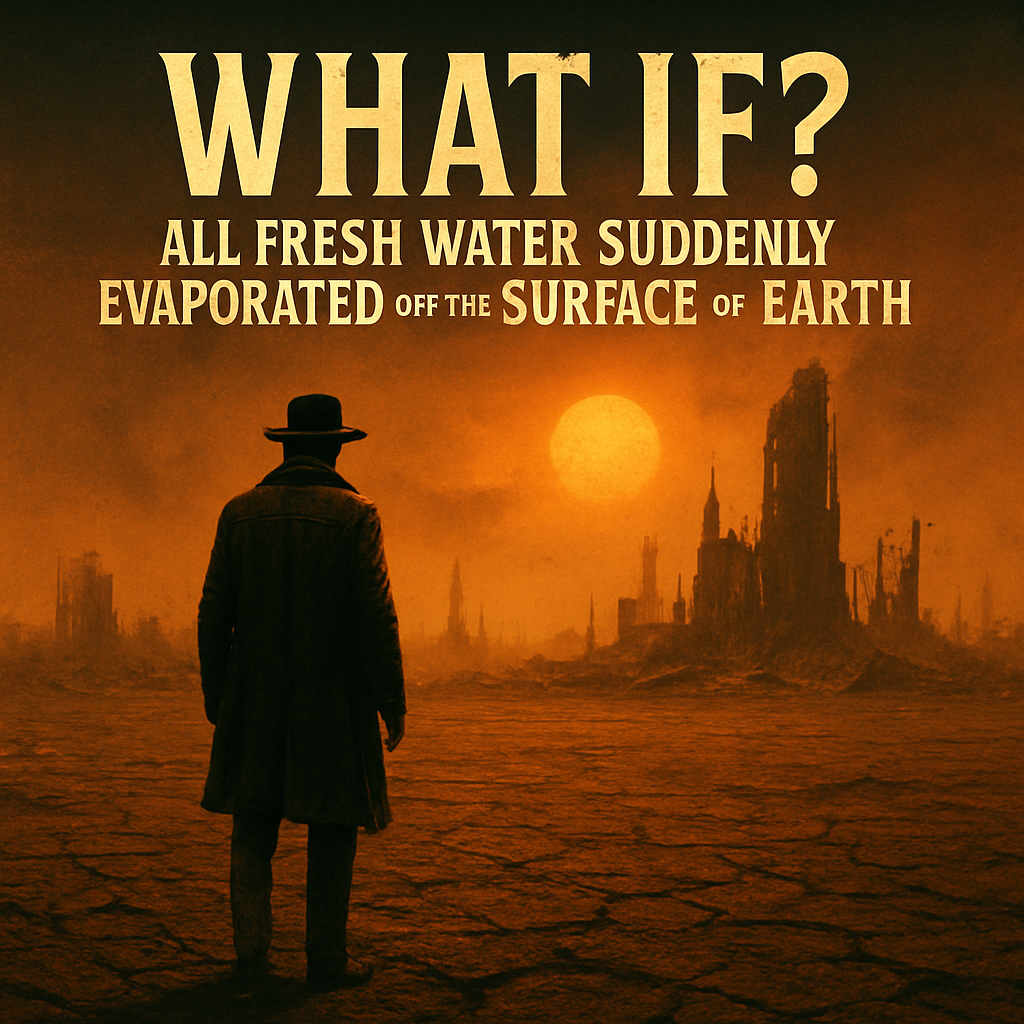
In a single moment, all fresh water on Earth evaporates, plunging humanity into chaos as rivers vanish and inland regions collapse into deserts. Coastal desalination cities become new superpowers while the rest of the world fractures into Dust States and water warbands. A botanist named Luka, driven by loss, joins scientists who discover the water is trapped in the upper atmosphere by an unnatural electromagnetic shift. Luka ascends into the sky to restore the molecular bonds of water, bringing rain back to the world-only to learn the catastrophe was not natural, but a deliberate test from an unknown intelligence.
I. The Day the Rivers Died
It happened so quickly that most of humanity didn’t realize anything was wrong until it was already too late. At 10:14 a.m. Eastern Time, a fisherman in Montana watched the surface of Flathead Lake ripple unnaturally, as though something beneath it had taken a long, shuddering breath. At 10:15, a woman jogging along the Mississippi River witnessed the waterline sink visibly, the mud banks widening with impossible speed. At 10:16, tourists in Canada stared in speechless horror as Niagara Falls thinned like draining bathwater, then vanished altogether, leaving only naked stone exposed for the first time in twelve thousand years.
By 10:17, every freshwater body on Earth-rivers, lakes, ponds, streams, reservoirs, fountains, even puddles-had evaporated into nothingness.
Not boiled. Not drained. Not transported. Simply gone, as though reality itself had flicked a switch and erased water from its surface layer.
Most alarming of all was that the oceans remained perfectly intact, swelling slightly as if puzzled by the sudden absence of their smaller cousins. Clouds dissipated within hours. Air humidity plummeted. Rain forecasts disappeared from global weather models like erased lines from a chalkboard.
The world realized in a single day that despite all human arrogance, despite satellites and sensors and laws and boundaries, despite economic power and military strength, civilization still depended on something fragile, something silent, something utterly irreplaceable.
Fresh water.
And now it was gone.
II. The First Week Without Water
The initial reactions were predictable: panic, disbelief, denial. Governments held emergency press conferences offering assurances they didn’t believe. Scientists scrambled to understand the phenomenon, sending probes into the atmosphere, drilling into dry lakebeds, analyzing soil samples, and studying the trace signatures on evaporated surfaces.
Nothing made sense.
“There is no known physical mechanism for this,” Dr. Asha Verin told the world in the first unified global briefing. Her voice shook despite decades of calm academic discipline. “The water did not heat. It did not rise. It did not migrate. Hydrogen bonding simply… stopped.”
By day three, the consequences became catastrophic.
Hospitals filled with patients suffering dehydration. Power plants relying on steam turbines shut down. Agriculture died almost immediately-crops drying like brittle paper under a sun that suddenly had no atmospheric moderation. Animals collapsed in fields. Insects vanished. Dust storms swept through once-green regions.
The first wars began by day four-not between nations, but between cities and their suburbs, between neighbors, between those who still had water hidden in tanks and those who didn’t.
Human life, once measured by wealth, was now measured by liters.
III. The Saltwater Divide
Only coastal regions had any hope of immediate survival, because only they could build desalination plants fast enough to turn ocean water into drinkable liquid. Instantly, geography became destiny.
Countries with coastlines became the world’s new superpowers, transforming from tourist hubs into armed fortresses. Desalination became the most valuable technology on Earth. Coastal cities erected vast military perimeters, preventing inland refugees from overrunning their limited supplies.
The inland regions-once thriving centers of global culture and industry-began emptying. Millions began walking toward the oceans, forming endless caravans that moved like dark rivers across barren land.
The old world map fractured into new classifications:
Desalination Kingdoms - coastal zones controlling the only viable water Dust States - inland regions abandoned to desert Glacier Territories - pockets of ice now guarded by militias Cloud Ships - airborne factions harvesting condensation at gunpoint
The United Earth Federation attempted to negotiate order, but diplomacy meant little when thirst burned every tongue.
Fresh water, once taken for granted, had become currency, power, survival.
IV. Luka’s Journey Through Dust
Luka Morvan had always lived far from the ocean. A botanist from Denver, he grew up beside rivers, surrounded by forests, comforted by the idea that nature always found a way to adapt. But the day the water vanished, a quiet crack formed inside him-a crack that widened as the city descended into chaos.
He watched entire neighborhoods raid grocery stores for soda and juice when the water ran out. He saw elderly neighbors collapse under the sun. He listened as his sister sobbed over a broken radio, realizing hospitals no longer had IV fluids. By the end of the second week, she was gone-dehydration stealing her from him in a slow, cruel process.
After burying her in dry soil, he joined one of the caravans heading west, searching for the sea. He carried only what mattered: a metal flask with his last water supply, a notebook filled with plant sketches, and his sister’s scarf.
Somewhere deep inside him, he knew he wasn’t walking toward the ocean. He was walking toward answers.
V. The Scientists Who Would Not Give Up
Even as society crumbled, a group of scientists at the Pacific Research Arcology-the PRA, an enormous floating platform off the California coast-continued their efforts to understand the phenomenon.
Their data revealed something disturbing.
The water hadn’t just evaporated. It had relocated into the upper atmosphere, suspended in a thin, nearly invisible layer where liquid droplets refused to bond, hanging in a shimmering plasma-like state.
Something had interfered with electromagnetism at a molecular level.
Something global. Something unnatural.
Dr. Verin and her team theorized a cosmic cause-an event so rare it might never occur again, or so deliberate that humanity was not alone in the universe.
Luka arrived at the PRA half-dead, dragged aboard by patrol drones who scanned him and declared him of “scientific relevance” due to his botany studies and unusual physiological test results. He didn’t understand what that meant yet.
But he would.
VI. The New Water Lords
While scientists searched for answers, new powers rose across the shattered world. The Desalination Kingdoms-California Coast, Japan, Norway, Chile, and others-became the centers of a new technocratic aristocracy.
Inside their guarded megacities, water flowed sparingly but consistently. Each liter was tracked, rationed, and assigned value. Water tokens became the new global currency. A single liter could buy shelter, medicine, passage, even lives.
Outside those walls, the Dust States fought for survival, raiding convoys, hijacking tankers, bribing smugglers, and attempting desperate, poorly constructed desalination rigs that often exploded.
Humanity had returned to a primitive economy, but with modern brutality.
Yet all of this-the conflict, the desperation, the rise of water kingdoms-was merely the first act of a larger story unraveling.
Because Dr. Verin had made a discovery.
And Luka was the key to understanding it.
VII. The Impossible Explanation
The PRA lab was a maze of humming machines, half-operational desalination modules, and battered equipment salvaged from research facilities long abandoned. Dr. Verin, exhausted and hollow-eyed, held a holographic model of a single water molecule over a workstation where Luka sat recovering.
“We have detected a global change in hydrogen bonding,” she explained, her voice steady with the calm of someone who had stepped beyond fear. “Water molecules no longer attract each other properly. They won’t condense on surfaces. They won’t pool. They don’t behave like water anymore.”
Luka frowned. “Why? What caused it?”
“That is the problem,” she said. “It wasn’t natural. Something interfered with Earth’s electromagnetic field in a specific frequency pattern. It looks almost… engineered.”
“You think someone did this?”
She hesitated. “Or something.”
The admission chilled him in a way dehydration never could.
But there was more.
“Your physiology,” she said, “is resistant to the electromagnetic shift. You can still form trace condensation on your skin. It’s faint, but measurable. Your DNA carries a mutation connected to ancestral adaptation to high-altitude environments.”
“So what does that mean?” Luka asked.
“It means,” she said, “you might be able to survive long enough to help us fix what’s been done.”
VIII. Climbing Into the Sky
The scientists determined that the water wasn’t gone-it was simply trapped at a high-altitude boundary where bonding had broken. Reversing the shift required bringing a stabilization beacon into that upper layer, reintroducing the proper EM frequency, effectively “resetting” the hydrogen bonds.
It was a one-way mission. The environment above the boundary was nearly uninhabitable. No aircraft could fly safely; their engines would stall in the anomalous zone. Only a human carried by a weather balloon, equipped with a manual release transmitter, could reach it.
Luka volunteered not because he was brave, but because the world below had become unbearable-a cracked planet full of dying soil and desperate eyes. His sister’s memory pushed him forward as strongly as any scientific purpose.
The ascent was hauntingly quiet.
Below him, the world looked bruised and broken. Rivers were dried scars on the land. Cities were dim husks. The ocean glittered with unnatural calm.
Above him, the sky grew pale and metallic, as if he were climbing into the bones of reality itself.
When he reached the boundary layer, he saw it-not with his eyes, but with a strange, prickling sense in his blood.
A shimmering membrane, like the thinnest possible veil, stretched around the planet, holding the water hostage.
Something had changed the rules of physics here.
Something had rewritten the atmosphere.
He triggered the beacon.
The membrane responded.
And then everything went white.
IX. When the Water Returned
Luka woke in a hospital on the PRA platform, drifting in and out of consciousness as the world below rejoiced.
Fresh water fell from the sky in a torrential, earth-shaking deluge. Rivers refilled like veins drawing blood. Lakes returned with roaring applause. Glaciers swelled. Even the smallest puddles formed on rooftops as the planet exhaled in relief.
Humanity sang. Cried. Collapsed in joy.
The wars paused. The ration lines ended. Power returned. Crops revived. Animals reappeared from shelters.
The water was back.
But something else had changed too.
X. The Unfinished Mystery
When Luka finally opened his eyes fully, Dr. Verin was sitting beside him.
“You saved us,” she said.
He shook his head weakly. “I only reversed the effect.”
“That’s exactly the problem.” Her expression darkened. “We traced the frequency. It wasn’t natural. It wasn’t cosmic.”
Luka stared at her.
She lowered her voice to a whisper.
“It was a message.”
“A message?”
“A test,” she said. “Someone-or something-wanted to see how we would respond if our most essential resource was taken away.”
“And now?” Luka asked.
She exhaled slowly, eyes trembling.
“Now we wait,” she said. “Because whoever tested us… knows we passed.”