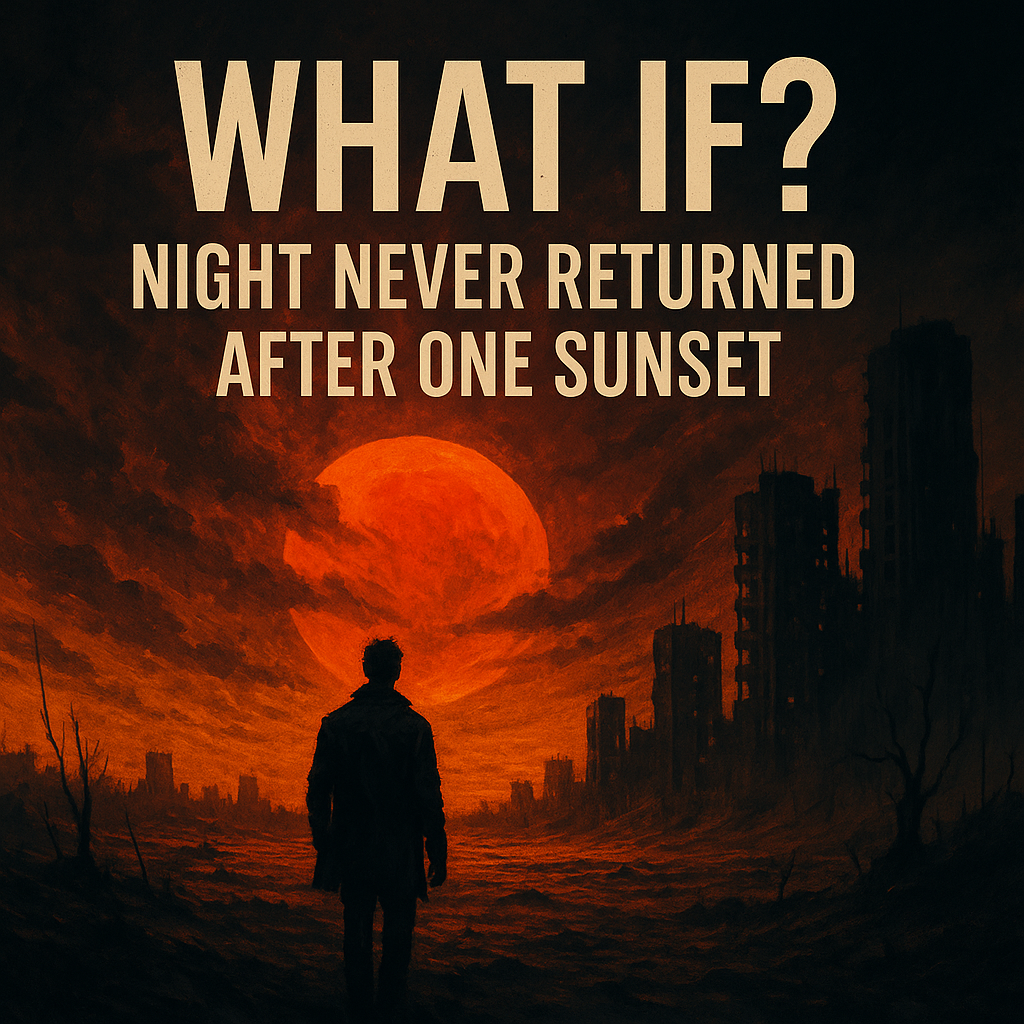
When the sun sets one evening and darkness never follows, humanity panics as an unending twilight traps the world in perpetual day. Stars vanish, shadows behave unnaturally, and a mysterious membrane wrapped around Earth blocks all cosmic light. As ecosystems collapse and sleep becomes impossible, strange light patterns appear in the sky—mathematical signals warning of something outside the membrane.
A global black line rises on every horizon, growing into a towering wall of pure void. Shadows detach from their owners, gathering like soldiers facing the encroaching darkness. Astronauts report a colossal presence circling the planet before all communication ends. When the black wall tears open, a vast cosmic entity emerges—something that hunts darkness itself.
Humanity realizes too late: night wasn’t absence of light. Night was a shield, created to block this ancient predator. And now that shield is gone.
I. The Last Sunset
It began beautifully.
The sunset on the night the world changed was unusually breathtaking—an explosion of violet and molten gold spilling across the sky. People photographed it from balconies, beaches, rooftops, desert cliffs, highways stuck in traffic, planes slicing above the clouds. Social feeds filled with glowing horizons. Couples kissed. Parents pointed at the sky. Children applauded.
No one knew they were watching the final sunset in human history.
When the sun finally dipped below the horizon… the darkness didn’t come.
Instead, the world remained lit with a soft, eerie, endless orange glow—like perpetual twilight stretched indefinitely across the sky. The stars did not appear. The Moon did not rise. The sky did not darken by even a fraction.
At first, people joked on social media that it was some atmospheric refraction anomaly.
By midnight, jokes turned into anxiety.
By 2 a.m., global panic began.
By dawn—though dawn looked exactly like midnight—humanity understood:
Night was gone.
II. The Day That Wouldn’t End
Scientists scrambled for explanations. Every major observatory on Earth confirmed that the sun was still where it should be—below the horizon—but its light was being refracted across the entire sky, wrapped around Earth as if trapped inside a glass sphere.
A shell. A membrane.
The atmosphere glowed as if the planet were inside a giant lantern.
Governments released statements urging calm, but they sounded absurd in a world that no longer had shadow or darkness.
Within 48 hours, the consequences became severe:
- Melatonin production stopped.
- Sleep cycles collapsed.
- Birds flew in confused circles.
- Plants twisted toward the horizon, unable to rest.
- Nocturnal animals went frantic.
- Farmers reported crops refusing to enter nighttime metabolic cycles.
Human biology itself began to protest the unending day.
Hospitals overflowed with people hallucinating from sleep deprivation. Traffic accidents surged. Anxiety attacks became epidemic. Entire cities began operating on emergency rotations, forcing citizens into darkened bunkers to simulate night.
Even underground, many couldn’t sleep.
It felt as if night had been removed not just from the sky… but from the mind.
III. The Stolen Stars
Astronomers pointed telescopes toward where the stars should have been visible beyond the false daylight.
What they found was impossible.
The stars were still there—brilliant, burning, unchanged.
But their light wasn’t reaching Earth.
Not one photon.
As if the entire universe beyond the solar system had gone dark at the exact same moment the sunset froze.
A thin, invisible something wrapped the Earth, blocking every wavelength of starlight, moonlight, cosmic background radiation—everything.
A shell around the planet.
A shell that reflected sunlight back inward.
“We’re in a light trap,” one astrophysicist whispered on a livestream before the feed collapsed under global demand. “Something is keeping the light in… and keeping something else out.”
IV. The Flickering Shadows
On day four, shadows began behaving strangely.
At first, they grew pale—barely visible on sidewalks or walls.
Then they started lagging behind movement—delayed, like a video buffering.
Finally, in some regions, shadows vanished entirely.
Psychiatrists reported that people in no-shadow zones experienced a sensation of being watched from behind—even when alone. Pets refused to enter shadowless rooms. Birds avoided shadowless fields, flapping away in panicked circles.
Children experienced it worst.
“My shadow is hiding,” one boy told his terrified mother. “It says it’s scared,” a girl whispered to a paramedic. “They’re coming,” another child murmured before fainting.
Governments dismissed this as a “collective psychological reaction.”
But children rarely make up the same nightmare.
V. Permanent Daylight Panic
By day seven, the world fractured.
Without darkness:
- insomnia ravaged humanity
- food chains broke
- power grids overloaded
- temperatures rose
- oceans warmed
- polar ice accelerated its melt
- insect cycles collapsed
- birds stopped migrating
- crops withered
- crime exploded under constant light
People sought refuge in deep caves, mines, bunkers—anywhere darkness still existed.
But even there, the faint orange glow burned in their minds.
Dreams no longer came.
Night had been stolen from consciousness itself.
VI. The Sundogs That Shouldn’t Exist
Then came the Sundogs.
Massive glowing halos around the sun—even though the sun wasn’t visible. Colorful rings formed across the horizon, overlapping in impossible geometric patterns. Spirals. Crosses. Constantly shifting luminous arcs.
Photographs from around the world revealed something terrifying: the patterns weren’t random.
They were identical. Mathematical. Repeating.
Each arc joined another like circuitry.
A message encoded in sunlight.
“We’re being signaled,” a linguist said during an emergency UN broadcast. “But by whom? Or by what?”
VII. The First Nightwalker
On day nine, a man in South Korea collapsed after five days without proper sleep. Paramedics revived him, but when he opened his eyes, they were completely white—no pupils, no irises.
He stood. Spoke. In a voice layered with echoing harmonics.
“Night is being kept out,” he whispered, though no one should have been able to speak more than a rasp from exhaustion.
“It is close now. We are not alone in the light.”
Then he smiled with cracked lips.
“It sees us.”
He died standing up.
His shadow was missing.
VIII. The Black Line on the Horizon
On day ten, people in Australia reported a thin black line forming at the far horizon. Hours later, the same line appeared in Africa. Then South America. Then Asia. Then Europe.
A perfect, global ring of darkness.
It rose slowly—meters per hour.
A wall of pure black, featureless, consuming nothing… yet growing taller, as if something enormous were approaching the planet from all directions at once.
Scientists argued:
“It’s a shadow.” “It’s a tear.” “It’s a rift.” “It’s the membrane cracking.” “It’s the edge of night trying to return.”
But children cried when they saw it.
“That’s not night,” they said. “Night doesn’t stand up.”
IX. The Astronaut’s Final Transmission
As the black horizon grew, the International Space Station ceased all non-critical operations to conserve power.
But one astronaut—Commander Raina Zhou—sent a final transmission before communications went dark.
Her video feed was shaky, oxygen alarms blaring behind her.
“There’s something outside the membrane,” she whispered. “Moving. Circling the planet. It’s big. It’s looking for the dark. It can’t get in.”
Sparks flew behind her. The station groaned.
“It’s waiting for the light to fail.”
The feed dissolved into static.
When rescue attempts launched, the ISS was gone.
Not destroyed. Not crashed.
Gone.
X. The Shadow Return
On day twelve, the black wall reached the height of skyscrapers.
And then… shadows returned everywhere at the same instant.
Sharp. Overly defined. Pitch black.
People screamed. Shadows moved slightly out of sync—like marionettes on invisible threads.
In some cases, shadows detached completely.
They pooled in the corners of streets, merged, and rose into towering humanoid silhouettes—tall as buildings.
They did not attack.
They faced east. Toward the rising black wall.
As if awaiting orders.
XI. The Myths That Suddenly Make Sense
A historian in Cairo cross-referenced thousands of ancient myths:
- Egyptian stories of Apophis devouring the sun
- Norse legends of wolves chasing night
- Hindu cycles of light traps
- Greek tales of night as a goddess protecting humans
- African folklore describing “hunters of darkness”
- Polynesian creation stories of the world wrapped in eternal day
- Indigenous American stories of the “Devourer of Night”
A pattern emerged: night was not merely darkness.
It was a shield.
A protective cycle.
A space where something dangerous could not enter.
Humanity wasn’t meant to live in constant light.
Night kept something out.
Something old.
Something patient.
XII. The Sky Tear
On day fifteen, the black wall reached its full height—stretching across the entire horizon, encircling the world like a colossal ring.
It shimmered. Hummed. Throbbed.
Shadows—all the detached ones—raised their arms toward it.
Then the wall split open.
A single vertical tear.
Behind it was no sky.
No stars. No night. No space.
Only pure void—starless, depthless, hungry.
Something vast moved inside it.
A silhouette the size of a continent. Arms long as mountain ranges. Eyes like collapsing stars. A form that twisted physics simply by existing.
Humanity stared upward, every breath stolen at once.
The thing stepped forward.
The light-trap membrane flickered.
The Sundog patterns halted mid-rotation.
The sky itself seemed to tremble.
And the creature leaned in close enough that its breath rippled through the atmosphere.
A whisper echoed—not in sound, but in thought, vibrating in every skull:
“THE DARK IS MINE. YOU KEPT IT FROM ME.”
The creature reached its hand toward Earth.
Light bent. Shadows screamed. The membrane cracked like glass under pressure.
And for the first time in fifteen days, true darkness seeped through the tear.
Not peaceful darkness. Not restful darkness.
Predatory darkness.
The kind that eats suns.
The kind that hunts universes.
The kind that night was created to hold back.
XIII. The Final Realization
Scientists, philosophers, children, and the dying all understood the same truth:
Night wasn’t the absence of light.
Night was the presence of protection.
Night was the barrier.
Night was the guardian.
Night wasn’t taken.
Night was hiding.
Running.
Because something ancient had finally found our world.
And it wanted what lived in the darkness.
Us.